What actually destroys a foundation
Water is the primary cause, but it rarely acts all at once. It works through the soil underneath the house. Muskogee's mixed regional soils hold moderate moisture, lifting the house slightly during wet stretches and dropping it when dry. After years of this cycle, footings settle unevenly.
Occasional winter freezes bring some freeze-thaw movement. When the ground freezes, water in the soil expands and pries open small voids and cracks. When it thaws, everything settles back down loose, and more water finds its way in the next time around. A few sharp freezes are enough to open up a foundation edge that was marginal to begin with.
The pattern we see most often is one part of the house moving while the rest stays put, usually where drainage has kept one corner wetter or drier than the rest. It takes the same small movement repeating season after season until something gives.
The signs worth checking yourself
Start inside. Walk the rooms and look at the corners of doors and windows, because drywall cracks running diagonally from a frame corner are the classic tell. Try the doors: one that used to close fine and now sticks or won't latch has probably moved with its frame. Set a marble or a level on the floor in a couple of spots. Floors that slope toward one side of the house are telling you where the movement is.
Then walk the outside. Look at the mortar lines on any brick or block walls and check whether any cracks step like a staircase instead of running straight. Look at where the chimney meets the siding and where trim meets the wall. A gap opening between brick and a window frame, or a crack wider than about a quarter inch, is a different animal than a hairline in the mortar.
The most common thing we find when someone calls about one obvious crack is a smaller second symptom they hadn't connected to it. A sticking door on its own might be humidity. A sticking door plus a diagonal drywall crack on the same side of the house is a pattern, and patterns are what we diagnose from.
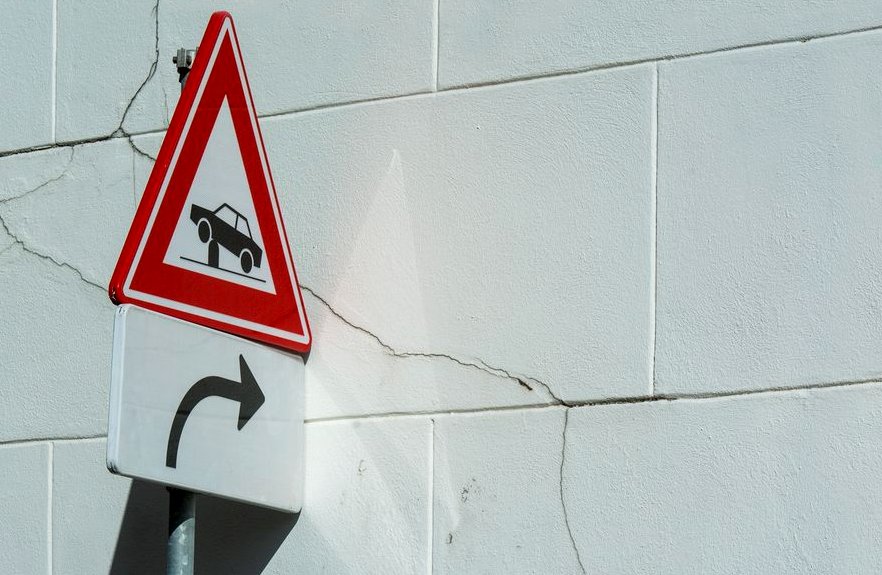
Which cracks matter, and which can wait
Hairline cracks in a slab or drywall, thin enough that a fingernail edge won't fit in, are usually shrinkage and can wait. Concrete shrinks as it cures, and most slabs crack a little somewhere no matter how well they were poured.
The ones worth acting on are cracks that are wide and getting wider, stair-step cracking in brick or block, horizontal cracks, and any wall bowing inward. A bowing wall requires quick action because, caught early, it can often be arrested with carbon-fiber straps bonded to the wall face. That is a far smaller job than rebuilding a wall that has gone past the point of strapping.
If you are not sure, mark the ends of a crack with a pencil and the date, take a photo, and check it again in a few months. A crack that hasn't moved and isn't letting water in can sit on the list for a while. One that has grown between checks requires a professional look.
What the fixes look like, and what they cost
Where the ground itself has let the house down, the fix is helical piers, steel shafts turned down to stable bearing that carry the footing from below. Those run $2,500 to $3,500 per helical pier installed. The final cost depends on how many piers a house needs, which comes down to the footprint and how much of it has settled. Nobody can quote this work over the phone.
A slab that has settled or tilted but is still sound can often be lifted instead of underpinned. One way is polyurethane foam, injected through holes about the size of a dime, which expands under the slab and raises it back into place. Where a job calls for more mass, we slab-jack instead, using a cement-based slurry pump to push material under the slab to fill the voids and lift it. Either way, the job isn't finished when the concrete moves. We run a post-lift re-survey to confirm the structure returned within tolerance, not just that it looks level to the eye.
If you want an independent assessment, a structural engineer's foundation inspection runs $400 to $1,500 depending on how involved the house is. We like it when a homeowner with a complicated case gets an engineer's report. It gives you a documented scope of what needs doing and keeps everyone on the same page.
From First Call to Finished Job
-
Tell Us What's Going On
A two-minute call is enough to tell us what we're working with and what to check first.
-
We Take a Look
We come out, measure what's actually happening, and walk you through what we find.
-
Know the Price First
You get the scope and the price in writing before any work starts. No surprises.
-
We Do the Work
We complete the repair, verify it solved the problem, and stand behind the work.
Depending on what we find, that can mean:
- Manometer survey to map differential settling across every room before any lift
- Soil bearing-capacity test to set the correct pier depth
What It Typically Costs
Ranges to budget around - every situation is priced on its own specifics.
$2200–$8100
Common Questions
In Muskogee, settling comes down to the local ground conditions: Mixed regional soils with moderate moisture retention.
The most common signs are cracks wider than a quarter inch, doors and windows that stick or won't latch, sloping or uneven floors, and gaps opening where walls meet the ceiling. Any one warrants an inspection; several together usually means active movement.
Hairline cracks in drywall are usually cosmetic. Diagonal cracks from window and door corners, horizontal cracks in a foundation wall, and stair-step cracks in brick or block are structural warning signs that should be evaluated.
Settlement is almost always about the soil under the footing. Expansive clay that swells and shrinks with moisture, poor drainage that washes out support, plumbing leaks, and loosely compacted fill on newer builds are the usual causes.
A Few More Questions
Foundation movement rarely stops on its own and usually worsens with each wet-dry cycle, so delaying tends to raise the eventual cost. An early inspection keeps options open and repairs at the lower end of the range.
Structural repair and water control are related but separate. Sealing cracks helps, but persistent basement water usually also needs drainage measures such as interior drain tile and a sump system.
A proper estimate includes a walk-through of the symptoms, a manometer or elevation survey, and a review of soil and drainage conditions, followed by a written scope with pier count, method, and price. Be cautious of any quote given without measuring the differential.
Serving Muskogee and Nearby
We work across Muskogee, OK. Call (918) 351-6948 to confirm coverage for your address.
Related Services
What You Can Hold Us To
- Free Estimates
- You pay for work, never for the quote.
- Local crew, local jobs
- Close enough to come back if anything needs a second look.
- No-pressure estimates
- Sit with the written scope as long as you need.
- We clean up before we leave
- The site's left the way you'd want it, not a mess to deal with.
Straightforward Pricing
Free Inspections, fast scheduling, (918) 351-6948.
Updated October 2026